Riff on Francis Murphy: 15 Minute Painting Demonstration!
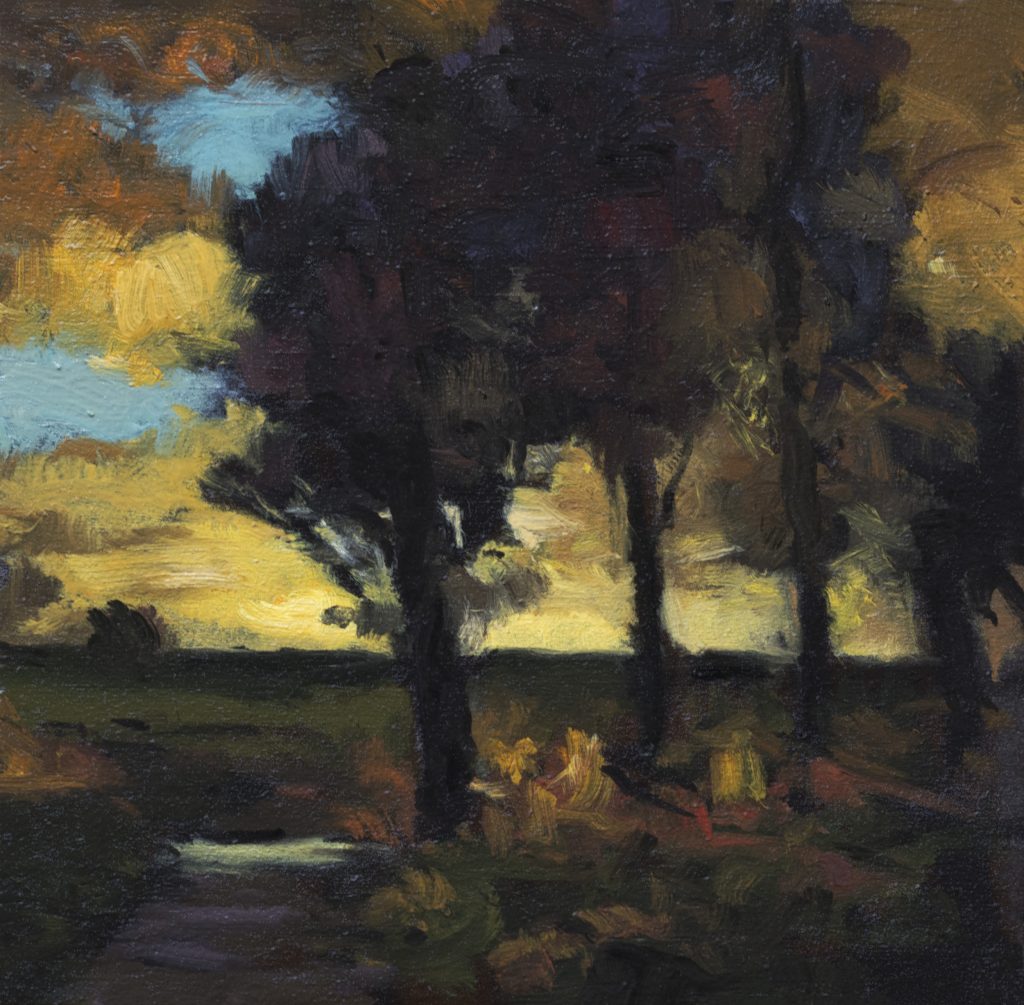
Welcome to another tonal landscape oil painting demonstration. This is your painter in residence, Michael Francis McCarthy. And the painting I’m bringing you today is called “Riff on Francis Murphy, Evening.” I painted this back in September of 2025 and I’ve been sitting on it that whole time. Let me tell you the tale.
The Board
That board’s probably been prepped since 2018. It’s been in a box, maybe even came home to my home studio and then went back to work. So it’s had its own journey with me already.
I was really enjoying working on this sort of color back when I first started the channel. I call it burnt umber, but it’s pretty dark for burnt umber. Actually, it’s the kind of tone you might get with burnt umber if you put a couple coats down—transparent as it is, it will get dark.
It’s not the best for the videography, but I do think it’s clear enough that we’re showing it today. And I have a little better chops with the video now. It was still quite new to me back then. Not just the video, I mean the camera, the Canon camera that I use to record my process. And I’m very proud of the progress that I made over the last year in my ability to get a very detailed photograph at the end of the session and also get the quality of the video recording right up there.
The Process
This whole painting session was about an hour, as it should be for this kind of thing. I really love this painting by Murphy and it’s not a square format like this. And this is the beauty of the riff, you know, you’re just making something based on somebody else and when it’s this size, it’s just fun to cut loose and do it kind of quick and get some colors down.
I didn’t record a palette at that time and I have to say boy it’s a lot less work putting these videos together without the palette. I have to say I really do love recording that palette process too, to be honest. I think it’s neat to be able to look over and see it. So that’s why I do it. But gosh, it’s nice just slamming in a video and turning off the sound and just talking over the top as we are today.
Working on Dark Ground
So we did our underpainting session and those light areas are where I would have erased with a paper towel or whatever. From the standpoint of video it’s not the most elegant color to paint on, but you ought to try it. The burnt umber is very nice to paint on.
I arrived at that color going over a bunch of old paintings—you know, paint that color over them because it was dark enough to cover most things. And in some cases you might even see a ghost image coming through. That was fine. I really loved working on top of old paintings for quite a while. I had a lot, and as I’m always pointing out in my materials, landscape painting is difficult. As you progress, you’re able to see the problems with your older work quite easily.
And a great solution is just cover those old paintings with some burnt umber and make a new painting right over the top. And that way when you’re famous in the future, you know, they’ll x-ray your stuff and they’ll go, “Oh my gosh, look, there was a failed painting below. Oh, this is a masterpiece.” Yeah, like that.
Not saying our little Francis Murphy riff is a masterpiece, but it’s a nice little painting. I don’t even know where it is. It’s in a box maybe right now. Sometimes these kind of things will sell out here pretty well. So I don’t know. It’s around.
Learning from Murphy
Beautiful colors. And I love Murphy, man. You know what a genius he was. And he brought so much to painting and I’ve learned so much from him.
And one of the things I’ve learned is just how to cut loose with the color. His painting is a master class. And you know, working that blue in with the other colors and still getting that nice tonal effect. And I really love to do that.
I found that quite challenging back in the days. Any time you had the blue with the orange, it was a thing. You’d have to deal with it. And it’s really easy to get an artificial result or even synthetic result.
And funny enough, I was working with one of the assistants and they automatically interpreted the idea of synthetic painting as negative. I didn’t bother to correct it because they don’t really care. But yeah, synthetic painting is not a negative. It’s just like synthesis in music—the bringing together of disparate things. And this is very much what tonalism was about. And Murphy was an absolute expert at it.
One of the things Murphy had was this beautiful ability to compose the scene. And that really is one of the main takeaways from him. But he could back it up. His work was incredible. I haven’t seen any of his work in real life, but I’m always doing a deep dive on the interwebs to see if I can find any new images.
But his masterpieces are there and I’ve made studies of them all. And his original “Evening” is definitely one of those. And you look on the channel, you can find it.
Anyway, I’m really super glad to present this. I had, you know, I always like to present my latest things. It doesn’t mean the things from the past that I haven’t showed you aren’t really cool. And this painting is super cool. And like I said, it reminds me I want to do more of this kind of thing.
The Book
I’ve got a nice order for the book this week. The book encapsulates 13 years at the time of its writing of learning how to teach myself how to paint in a tonalist way. It’s jam packed with information, including my texturizing process. Check it out. $65 US, international shipping included.
Following Your Artistic Flow and the Source
There is a season for everything that you’re doing with your painting. One period of time you might be into painting ponds, another time into trails or seascapes or whatever. It’s important to just go with the flow.
I brought in these purples here. Now, I don’t know if Francis Murphy had them in his painting or if they’re just a result of the reflection, because we’re not looking at his actual painting. I’m looking at a photo somebody took of it. And you always hope it’s a good photo. But you know, whatever, we’re lucky to get any kind of impression of this stuff.
And it also points out a really good point about how, and I’m always talking about this because I think it’s important for us as moderns to realize: back in John Francis Murphy’s day when he painted this, to see this in color, you would have had to be alive and in the same room with it, right?
There was maybe engravers at the time that could have made a pretty good black and white version for you to check out. But you certainly couldn’t apprehend the painting as we can easily now. We’re surrounded with images on a daily basis. It’s quite easy to take that for granted.
And in a sense, it devalues us as painters since we’re in the image-making business. On one hand it does. On the other hand, it frees us to express ourselves without the constraints of commercialism. And back in Murphy’s day, that was a real factor.
On Tonalism and Recognition
If you’re interested in John Francis Murphy, definitely check out the book A History of American Tonalism by David A. Cleveland. I did an unboxing of his third edition here on the channel and I’m a huge fan of him. His writing is wonderful and his book is amazing.
If you want to learn about John Francis Murphy, that’s about the only place that you’re going to get a comprehensive overview. I mean, the chapter on John Francis Murphy could definitely be extended into its own book. And if any of you know David, I think you should suggest he do that book because his chapter on George Inness is amazing, but George Inness has been covered thoroughly by a lot of excellent authors. I think if David A. Cleveland was to do a book on John Francis Murphy, it would be so appreciated.
He was certainly influenced by George Inness. Once George kicked in, we’ve got the Tonalist stuff. But people didn’t want to know. They very much resented the intrusion of the European style into the American zeitgeist, okay? They didn’t like it. And he represented that to a large degree.
He wasn’t the only one. There were other ones, but he was the big one. And he finally got his due. He finally achieved the recognition for what he was doing that he deserved. And he was like in his late 50s, early 60s, I believe. He died unfortunately, I think early 70s. But at least he saw that recognition while he was alive.
And the same thing could happen for you and the same thing could happen for me, you know, especially. Even John Francis Murphy had quite a lot of recognition in his own day. But he lost a bit of that because he had a family, he had to produce a lot of paintings that were, you know, pot boilers—just something you’re doing for commercial reasons. And they have a lot of similarities: it’s a pond, it’s a farm, it’s some trees, you know.
That’s it for this painting. I hope you enjoyed watching me put it together.
Take care of yourself, your family, all your loved ones. Stay out of trouble. Fight the power.
Mike New Site | The Book | Gallery | YouTube | Members Area | My Music