Arcadian Road 4×6 – 15 Minute Painting Session
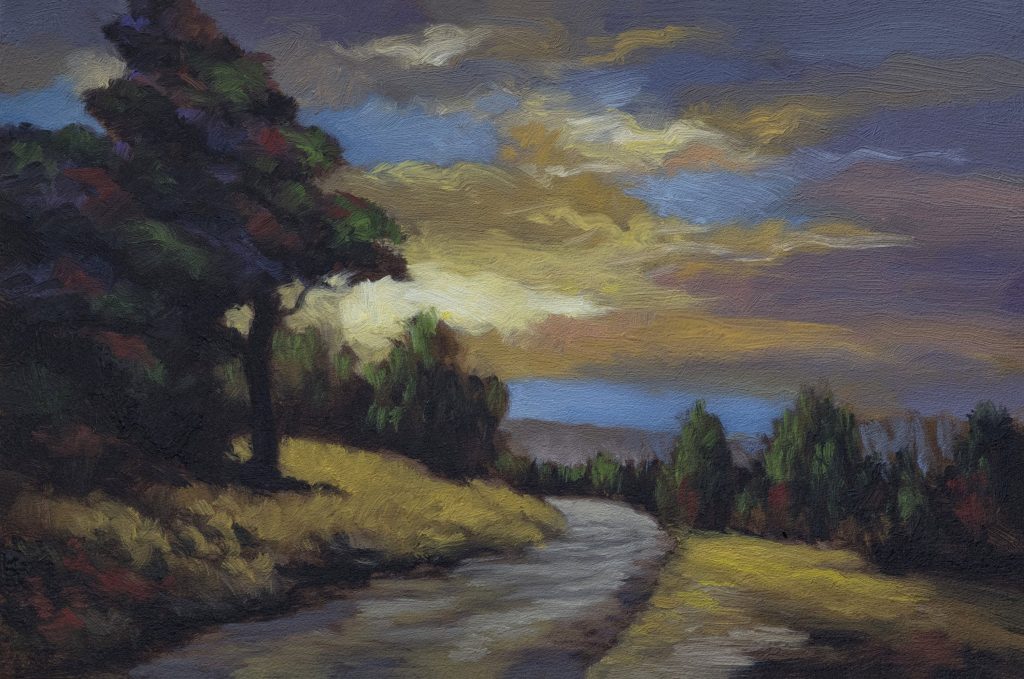
The painting I’m bringing you today is called Arcadian Road. It’s a 4×6 and I painted this a couple weeks ago.
The Palette and Reference Philosophy
This is our palette. I have a palette with all the tags on it in the video, and if that helps somebody, I reckon it’s a good thing. The reference is just part of the process. When you’re starting out, you think it’s really critical, but it’s not the painting. The painting is not the reference. The reference is not the painting. If you want to see the reference image, go to the members area, it’s there right now in 4K with no ads, and you’re supporting old Uncle Mike here, which is great. I’ll be putting it out live on the channel too in a week or so.
The Scene and Its History
This scene, I’ve painted it a bunch. I’ve cropped in on it, zoomed down on it, done it in different perspectives. I probably first painted it about ten years ago when my wife and I took a reference-collecting trip towards the west coast here in North Island, New Zealand. There’s a lot of what are called metal roads, roads that farmers and people in rural areas use. I captured the reference I use for this scene and I’ve configured it a lot of different ways. I always take liberties with it. As a matter of fact, the video just came out on the channel, an Easel Talk about imagination over reference, basically using nature and not imitating it. Check that out if you haven’t already.
Why Small Paintings Matter
I’m doing these small paintings because there’s a tourist market out here, and they can afford the smaller ones more. I’ve done better with four by sixes and three and a half by fives than I do with five by sevens, which are still quite small. The minis attract people. They have a sort of precious jewel-like quality.
When I was done with this one, I thought it was okay. But in successive days, walking by it in the drying area, I kept thinking, well, that looks really pretty neat. To the point where when I was looking for something to share with you guys today, I was thinking, yeah, I like that one. I think it’s neat. A lot of color in the sky.
Breaking Up the Sky and Aerial Perspective
One of the things I’ve been trying to do is break things up in the sky. I tend to get a lot of little rows of things, and that’s because that’s how clouds work. But photography exacerbates that because it has a way of flattening everything. When we’re perceiving clouds in reality, we’re getting a lot more depth and aerial feeling to things. A photo is just going to take everything and slam it down flat.
You always want to try and introduce some variance, some perspective. When I’m setting up the reference photos, I’m always swapping out the skies. When you’re swapping out skies, a lot of times afterwards you have to add a gradient. I’ll add a gradient on a layer that’s just white coming up from the horizon, which brings in that sort of aerial perspective into things. That’s always good to do. In this case, I felt like doing that strong blue on the bottom, which was a little different for me.
Building the Landscape: Dark Patterns First
We’ve moved on, skies done, looking pretty cool. As is my way, I go in after we’ve got some sort of dark set up in the underpainting. The first thing I like to do is just get my darkest arcs in so I can build up from there. You really want to have your darks kind of set up from the word go because it’s very difficult to plop dark paint on top of wet paint that is lighter.
Here’s another tip: when it comes to your darks, you want to really make a solid effort to connect things up. You don’t want to have a polka dot sort of thing going on everywhere. Every way you can, you want to connect your dark shapes together. The darks are especially in my work, which is quite contrasty, the darks are going to be the anchor for the whole painting. They’re going to be the visual thing that holds everything together. All the other elements are kind of circling around, like the sky or the grasses.
A Critical Tip: Golden Grass Over Green
Here’s a tip I pass along a lot. In the reference, you’ve got green tree, green grasses. That’s an opportunity for you. Don’t do those grasses green. Make the grass golden and straw-colored. That’s going to add a lot more variety and depth to the scene. A real good way to obviate that green, green, green thing.
It’s a value game. You would have a dark green, you set that out with a dark brownish rust tone. Then you mix a middle tone that’s a goldy color, and mix a lighter tone that’s like a little bit of cadmium yellow in it or something. Then you get grasses, and they look great.
The Challenge of the Road
The way this road kind of ended up here, it works okay. That was a bit of a challenge. It looks like we’re going up the hill slightly. The road is always a challenging part of the landscape, something you gotta work on. I’m still working on it. The sides of the roads, the edges of the roads, less challenging than the end of the road, but it needs to be finessed. It needs to be done in such a way that everything is working together.
In this reference, the grass is already gold, so that was quite easy. But in a little painting I was doing earlier in the week, I caught myself. I’d already mixed greens for the grasses, and I’m thinking, wait a minute, this would be a lot more interesting. I had a green tree already, let’s make these grasses gold. That’s what I did. Yeah, I think this painting turned out real nice. It’s a sweet little painting. Someone’s really going to enjoy it.
The Value of Small Paintings
You might be into doing big paintings, and there are a couple of issues with that. Not an issue if you’re an artist who’s selling a lot of work and galleries have got a big demand for big things. I’ve had galleries ask for big things in the past, not so much lately. But the thing is with the little paintings, first of all, it’s still an artistic statement, but it’s something that people can afford. You can sell it quite reasonably.
When people invest in your small works, what they get for an affordable price is an original, one-of-a-kind thing. We’ve got images everywhere now. You could sell prints, you could do whatever. You can try and create a name for yourself as an artist. At the end of the day, it’s your paintings that matter. Small paintings, if they’re beautiful, will be well regarded and desirable. People will want them. That’s valuable. It’s intrinsically valuable.
The great thing about small paintings is that you make your statement, you make a picture, and it goes fairly quickly. You’re done. It doesn’t take a lot of room to store it. If you want to sell it when you get ready to, if it turned out good enough to sell, you just sell it reasonably. Someone goes, “That’s so sweet. It’s so cute. It’s like a little gem.” You go, “Hey, no problem. Hundred bucks. Give me your money.” Then you could take that money and go buy another tube of paint.
That’s pretty much it for this video. I hope you enjoyed watching me put this together. I’ll be back real soon with another painting, God willing.
Mike’s New Site | Substack | Painting Website | Mailing List | Store | My Music | Support | Members Area