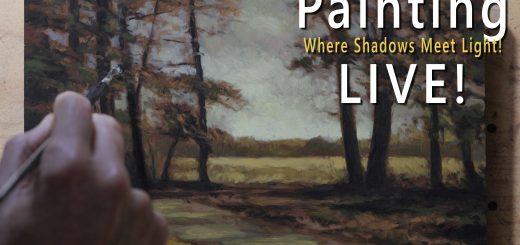
After the Rain 4×6 – 15 Minute Painting Session!
Transcript and Key Insights
I painted this last week based on a photo I took back in 2012 during a trip to England. I’ve made several paintings from this reference over the years, all of them bigger than this one. Back then, I was doing a five by seven study followed by an eight by ten version. I actually sold the five by seven to another artist.
I got out of that whole five by seven study approach because I was consistently more thrilled with the smaller version than the larger one. Much of that came down to composition and proportion issues. I’ve always found eight by ten horizontals to be not optimal for landscape painting. You can make them work, but back then I had the idea of just adding more sky to the top, and that was a bad plan. Where your trees relate to your sky is super critical.
How Composition Evolves
Going through my old references recently, I could definitely see where my ability to change up the photo reference to enhance the composition has been one of the major places I’ve grown. There are things that are very easy for me to spot now that I clearly wasn’t seeing back in 2012. As I progress through that folder of references, I have less and less reason to adjust things because of my enhanced capacity to create better compositions.
Composition is best learned through experience. This is 100% true. I have a copy of “Composition of Landscape Painting” by Edgar Payne, which I recommend you pick up. It’s a great book. But I had that book back in 2012 and was still making compositions that weren’t as successful as many I come up with today. This is one of the main areas where you’ll expand as a painter.
The Sky Strategy
The sky in this painting is really inspiring. One thing I like to do is leave an area where the board is still visible, and I come in quite light with that. This is something I really wasn’t doing back in the day. I didn’t have these areas of much brighter contrast in the sky. That’s something I almost insist upon now because it helps make the paintings better.
Having an area of real lightness and brightness is vital and awesome. You need some areas in your tonal painting that are pretty bright. It makes a real difference in how the painting reads.
Managing Long Shadows and Ground Plane
This scene has definitely some long shadows on the ground because the light is coming clearly from the right side. I did indicate that somewhat, but I didn’t want to get trapped by it. When you have things like long shadows on the ground, that’s an area that can become a real issue or trap. Those horizontal streaks can take over your painting if you’re not careful.
In this piece, I love the streaks of horizontal shadow on the foreground, but I made an effort to keep them broken up and not let them become too tyrannical. You’ve got to balance that visual interest without letting it dominate.
Intuition Comes From Experience
One place I felt I really succeeded was with the tree tunnel in the center, the area where you can almost walk or drive through. In the reference, there’s a dark black wedge going up. I painted it the opposite way, and this looks and feels way better. That’s something I did intuitively, like most things I do in my painting. But here’s the thing: the intuition is 100% fed by experience. It’s not a magical process, well, it is a magical process, but it’s one you can train.
You can definitely work to make your intuition stronger and stronger. The way to do that is by creating a lot of paintings. Do little four by sixes like this one. You could maybe do even one a day, and then set the world on fire.
The Painting Process
When I started this piece, everything was pretty dark. There’s quite a lot of underpainting with darks on the whole left side, the trees and things. We’re missing the actual dark painting session, but it was only five to ten minutes anyway. What I’m doing here is a bit like sculpting. I’m coming in with lighter and lighter tones, building up the form. If I were sculpting, I’d knock away more and more to reveal the form in the stone. With painting, it’s an additive process, but the ideas are similar.
The key is building from your darks and pushing into the lighter values carefully, letting each layer inform the next. That’s how you maintain control while still capturing the energy of the scene.
Mike’s New Site | Substack | Painting Website | Mailing List | Store | My Music | Support | Members Area
M Francis McCarthy, Your Painter in Residence