Sunset Serenade 5X10 – 15 minute painting session!
Transcript and Key Insights
The painting featured in this session is titled Sunset Serenade, a five by ten-inch piece completed just last week. It is essentially a sky painting, a subject I have explored extensively over the past fifteen years through what I call the “Sky Series.” The concept behind this series arose from collecting images of skies that were too compelling to simply be background elements in my landscape paintings. When a sky possesses such intense drama or beauty, it tends to draw all attention away from the foreground land masses. Therefore, the decision was made to create works where the sky is the primary subject, with minimal, often invented, landforms to anchor the composition.
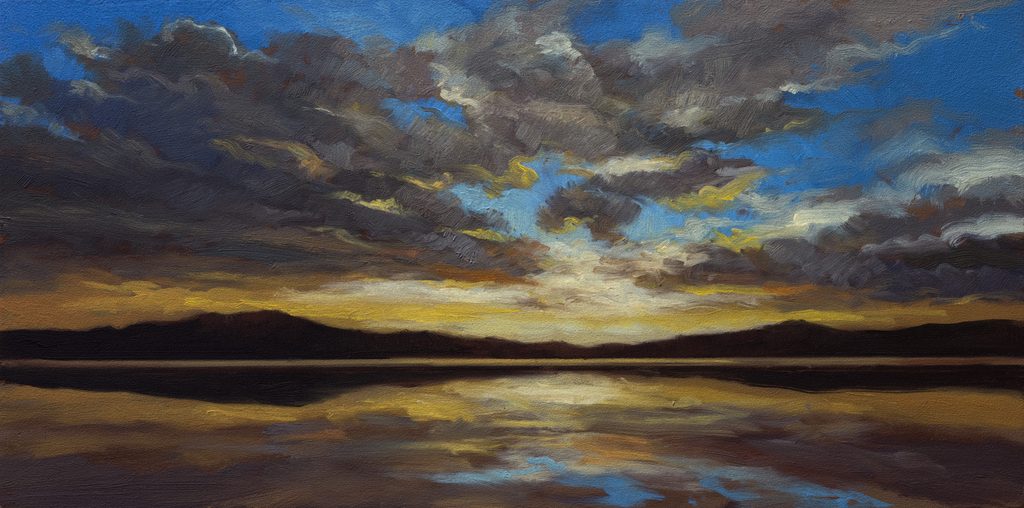
I had painted this specific scene two or three years ago and was very happy with the previous version, which I believe I sold. However, having kept the reference image around, I felt compelled to paint it again. This raises an interesting philosophical point about artistic repetition: you cannot walk in the same river twice. Even if you use the exact same reference, the result will always be different because the artist is a different person each day. While we have continuity and memory, our technical skills, moods, and interpretations evolve. The only exception to this rule of variation is formulaic, factory-style art production. I have experience in that sector as well; previously, as a manager for a hospitality supplier, we produced thousands of airbrushed, stencil-based mountain scenes for lobbies. Those were original art pieces, but they were identical by design. In contrast, my personal work relies on the subtle variations of human intuition and brushwork, ensuring that no two paintings are ever truly alike.
Color Mixing and the Mystery of Clouds
For the underpainting, I am working with a mix based on our usual “Burnt Umber” on a deep earth color, juiced up with Madder and perhaps a touch of Mars Black to create quite a red tone. While I don’t always have a specific reason for starting with such a strong hue, it is part of the experimental nature of the process. For those interested in the specifics, my live painting sessions available in the members area include color mixing demonstrations using the same reference image. Combined with the video palette, these resources provide all the keys necessary to create your own version of this painting.
One of the most fascinating aspects of painting skies is the behavior of dark clouds. In Sunset Serenade, there is a ridge of gray clouds that I initially painted with quite a lot of purple injected into them to create visual interest. Dark cloud colors can be mysterious; they shift between blue, brown, gray, and violet constantly. It reminds me of the simple physics at play: clouds are essentially water vapor suspended in air. That gray tone is simply water waiting for its threshold to be reached before it drops as rain. This natural shifting quality makes painting them a dynamic challenge, as you are trying to capture a momentary state of flux.
The Importance of Coherence and Repeating Colors
A significant portion of my creative process involves adjusting tones as the painting progresses. It is very typical for me to start with fairly gray or muted base layers in the sky. However, once all the other colors are introduced into the composition, it almost always occurs to me that I need to lighten those initial areas. This highlights a key lesson in painting: you often cannot know how things will develop until you start doing them. Painting is an iterative process of discovery and correction.
I have been reviewing this painting for several days since completing it, and I am very pleased with the expressive quality of the brushwork. The subject matter itself, a mass of clouds interacting with light and water vapor, demands a loose, fluid approach to capture its essence. This brings us to a crucial tip for landscape painters: consistency in color placement creates coherence. If you introduce a specific color in one spot, do not leave it isolated there. Find other places to echo that hue throughout the piece. For example, in this painting, I dabbled orange into and around various areas of the cloudy mass. This technique ensures that the painting feels unified.
Coherence is arguably the least complex thing you need to accomplish in a painting, but it is foundational. If you manage to achieve coherence, you are on a great path toward beauty because true beauty is always coherent; it makes sense and avoids unnecessary discordance. While there is room for abstract or distorted interpretations of art, in traditional landscape painting, visual logic and harmony are paramount. I recently watched a video titled “Beauty is Not Subjective,” which resonated with me. One can apply objective standards to define something as beautiful, distinct from personal desire or interest. A painting that feels disjointed may still be interesting, but it lacks the inherent beauty of a coherent whole.
Managing Light and Perspective in Sky Paintings
In Sunset Serenade, the light source is positioned centrally, creating a strong payoff point for the viewer’s eye. I mixed two versions of this lightest tone, one bluer and one more orange, and blended them together in the center to create that intense radiance. As I recall, I planned to make it even brighter as I progressed upward. Generally, unless you are painting a foggy or rainy scene where subtlety is required, you need a bright focal point in the sky. It serves as the anchor for the composition.
Interestingly, many of these dramatic sky scenes are originally captured with wide-angle lenses because photographers want to encompass as much of the sky as possible. However, this can introduce visual artifacts. Wide angles stretch edges and distort proportions, making things look weird at the periphery. As a painter, I try to correct for this by keeping “human scale” in mind. Human perspective is best represented by a focal length between 45 and 50 millimeters. For instance, in this painting, there is a mass of clouds on the upper right that was much lower in the original reference photo. I moved it higher because it felt more proportionate to how we naturally perceive such scenes. We don’t see the world through a wide-angle lens; we see it with eyes that process depth and scale differently. By adjusting these elements, I aim for a representation that feels intuitive and balanced rather than merely photographic.
Refinement Techniques: Using Mirrors and Video Cameras
As the painting nears completion, the final stage often involves catching subtle errors that are invisible to the naked eye while working closely on the canvas. In this session, I noticed a small split in the cloud formation that was distracting. My method for spotting these issues is to look at the video camera monitor during the recording process. Although the image is reversed and not large, it offers a different perspective that can reveal patterns or disturbances you might miss when looking directly at the wet paint.
This technique is easily replicated in any studio without technology. I highly recommend using a mirror if you aren’t already doing so. You don’t need to use it while actively painting; rather, wait until you feel you are wrapping up and think, “I’m done.” At that point, hold your painting up to a mirror or bring the mirror over to the canvas. This reversal tricks the brain into seeing the composition anew, allowing eyes to jump on imbalances, distracting lines, or color clashes. It is a powerful tool for final refinement. Of course, no method is infallible. There will always be decisions I make that I question later, but I file those away as lessons for future similar problems.
Supporting the Community and Future Projects
I am dedicated to sharing my process. I find it endlessly fascinating to see how paintings come together. My primary mission on this channel is not necessarily to teach in a rigid sense, but to share what I do, which serves as both inspiration and education. It makes no sense to record these sessions if they are never shared. I have hard drives full of unshared material that I plan to eventually consolidate into a comprehensive website dedicated to landscape painting.
If you found value in this session, please consider joining my members ares . Support for channels like this is vital as we navigate changes in YouTube’s algorithm and revenue models. Additionally, if you haven’t yet ordered my book on tonal painting, it is available for $65 US with international shipping included. It contains thirteen years of exploration and explication on the subject. I am also currently working on a new book and producing a video series called “Easel Talk,” with this week’s topic being “Painting Rocks,” which is a challenging but rewarding subject.
Thank you for joining me in pulling together Sunset Serenade. It has been a pleasure to discuss these insights, from the philosophy of repetition to the technicalities of color coherence and perspective.
Take good care of yourself. Stay out of trouble. And fight the power.
Mike’s New Site | Substack | Painting Website | Mailing List | Store | My Music | Support | Members Area
M Francis McCarthy, Your Painter in Residence