Rivers Edge 7×12 – Live Painting Session!
Transcript and Key Insights
Good morning, evening, or afternoon. It’s your painter in residence, Michael Francis McCarthy. And I’m going to be painting an all-in-a-row scene with some strategies for alleviating that. It’s a pond scene with trees, blue sky, give or take.
The reference photo has been tinted yellowish, but it’s unabashedly green. Although I’ve done things to balance that, this is pretty much going to be a green painting. Green painting, blue sky—yellow grass in the distance. This image was made from something; I don’t remember what the original was. It’s been sitting in a folder for about three and a half years.
Today’s Monday, usually my easel talks are on Sunday. But since it’s your day, I come in just to talk for a bit. We did that. This is our underpainting color—mostly Burnt Umber with a little Mars Black and some other colors. I want to go slightly lower than the reference here.
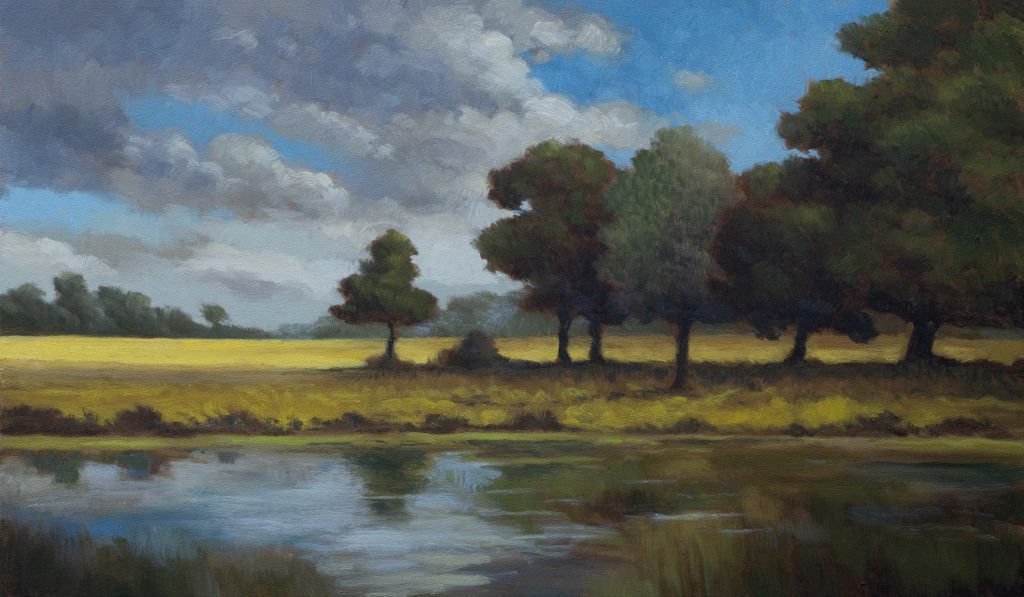
I don’t enjoy the shapes of the trees; they’re not refined, but I’m trusting my instincts as a painter to make something great. It has an ennessy feel, and that’s really what I’d like to do today. Also, I was looking at a painting on the wall behind me with a convexity issue. Don’t do convex—always go concave.
Reflections on Painting Techniques
I’ve been watching some videos by Jakedontdraw on YouTube. He does it well. The plumb line is brilliant, and I use my M. Francis grid. Now I’m moving this tree trunk over from where it is in the reference because I want to establish shapes.
I don’t love the shapes here, so I’m doing my own thing. That’s not too bad. Also, we can work with the negative space, introducing positive shapes. Don’t think you have to solve every problem all at once. A lot of your problem-solving is done by intuition and subconscious processes.
Color Mixing Session
This color looks really good, and I almost didn’t do a seven-by-12 today because it could crash and burn. But I got a good feeling about it. So I crashed and burned with one painting but communicated what went down in others. This is a seven-by-12 and an old failure scene.
I worked on this composite reference yesterday, and I wanted to paint it. Seven by 12 might be bad news, but I’m not going to be afraid. I’ve had successes with the size, so far it’s looking nice.
Painting Process
Now we have a darker tree, which is one of the things that makes this attractive. There’s no trunk there, and we’re watching how these intervals look okay, right? But we need to be careful about the pattern we set up, and I do want a trunk. Nothing’s in stone at this point, but I’m happy with this brush.
There is no trunk. I was getting a lot of oil in the paint there. Sometimes if you don’t like what’s in the reference, you look to change things, but obviously, you might get that loss feeling. Loss feeling’s okay; just keep painting.
Challenges and Adjustments
I’ve had successes and failures. Some parts are more challenging than others. This is a bit of a challenge, and these trees feel similar weight-wise, but I think we’re okay. Not bad clipping.
This brush has been doing a good job, though I’m trying to be gentle with it. There’s no trunk, and I have to say this brush is working well. The intervals are the same, so we don’t want that. Now this tree is lighter, even though I used the grid, but I’m not cleaving to the reference 100%. Most references do have problems.
Reflections on Artistic Process
I don’t use those big capital-letter words AI because algorithms seize on them. It’s a human process, and you may use some contrivances like the plumb line. That’s okay; let’s embrace it.
This color looks really good, and I almost didn’t do the seven-by-12 today. It could have crashed and burned, but I got a good feeling about it. So I did crash and burn. One painting was bad news, but then another turned out great.
Final Adjustments
I worked on this composite reference yesterday, and I wanted to paint it. Seven by 12 might be problematic, but I’m not going to be afraid. I’ve had successes with the size so far, and it’s looking nice. Now we have a darker tree which makes this attractive. There is no trunk in the original.
We need careful intervals, and I want a trunk. Of course, nothing’s set in stone yet, but I’m happy with this brush. It’s doing well.
This is not the horizon; it’s just my center line. I need to get out of here. This has high-quality paper towels that throw little bits down. Here’s the real horizon line. We have a connecting bit there.
We need a smaller mass there, and in the reference, it throws behind and then lighter on top. But we’re going to make it relate. Think about darks and lights, like yin and yang. I’m happy with that.
Concluding Remarks
Before we go back, start working on our shore. It’s grasses right up to the pond. I see that this is not the horizon line; it’s just my center line. This isn’t helpful.
The horizon line could be a problem, but we’re going to fix it. It’s not just one trunk, but two. Some of this can be vague back there. We need to reckon with all-in-a-row challenges and keep painting.
Too much oil here. A light tree over dark is always challenging. This will involve highlights. I like when it’s completely dark, trying to add highlights in there.
We don’t have that many good paintings, but you can still tank out. Let’s solve this. It’s not just one trunk but two. Some of this can be vague back there. We need to reckon with all-in-a-row challenges and keep painting.
This tree needs an interesting shape as we’re close to finishing the drawing. A light tree over a dark background is always challenging, and I like it when it’s completely dark with highlights in there. This will involve some overlap.
Just a little bit left to do on the drawing. I’m really pleased with this brush. The job it’s doing is excellent. You can leave; this chair doesn’t have arms but leans back perfectly.
Final Thoughts
I’m almost trying to get better at painting reflections, mixing vertical and horizontal strokes while avoiding diagonal ones. It’s definitely something you want to achieve.
This reference looks good, a bit abstract. I make that dark to add light-colored grasses in the corner. That’s an anchor. We need it for all-in-a-row challenges.
Thank you for joining me today. I’m pretty happy with how things are going so far. See you later!
Mike’s New Site | Substack | Painting Website | Mailing List | Store | My Music | Support | Members Area
M Francis McCarthy, Your Painter in Residence