River’s Edge 7×12 – 15 Minute Painting Session!
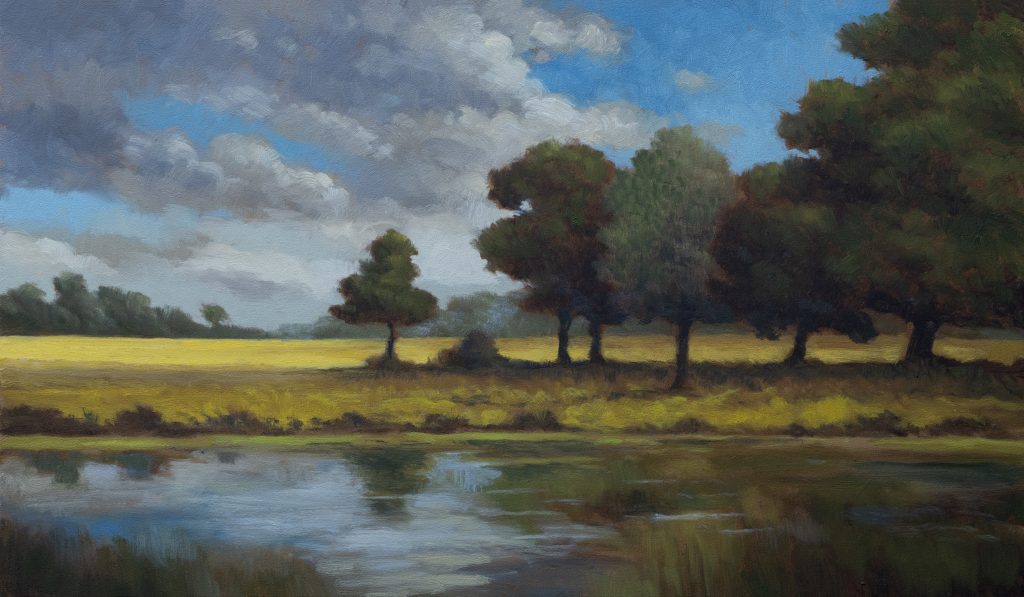
Welcome back to another installment of my 15-Minute Painting Sessions! In this edition, I’m excited to share with you the process behind “River’s Edge,” a 7×12-tonal landscape oil painting that I completed last week.
The Inspiration and Challenges
This piece is a revisit and refinement of an idea that has been floating around in my head for some time. The initial inspiration came from a digital concoction based on various elements I’ve encountered or imagined, but the execution required significant adjustments to bring it together cohesively. One of the main challenges with this type of scene—what I call “all-in-a-row syndrome”—is when subjects line up too neatly, creating a monotonous visual rhythm. To combat this, I incorporated elements like a river or pond, added distant features such as a lit-up meadow and copses of trees in the background, and balanced grouped masses of trees with isolated ones to break up any uniformity.
Balancing Composition and Visual Interest
When tackling skies with blue hues and gray clouds, it’s important to think about water and air. The transitions in the sky are largely determined by moisture content; more water means darker, grayer clouds. This mindset helps maintain soft edges and smooth transitions rather than stark contrasts. In River’s Edge, I weighted trees on one side of the composition and balanced them with clouds on the other. Ensuring that these elements interact harmoniously is crucial for achieving a satisfying visual experience.
Incorporating distant features such as the lit-up meadow and copses of trees helped break up any uniformity in the scene. These elements add depth and interest, making the painting more engaging and dynamic. The interplay between grouped masses of trees and isolated ones also contributes to this balance, preventing a staccato pattern that can make a composition feel repetitive.
Handling Foliage with Flatness
Drawing inspiration from George Innes, I aimed for fewer sky holes and a flatter approach to foliage handling. By keeping highlights within certain tonal ranges, you avoid introducing unnecessary volume, maintaining the flatness that characterizes tonalism. This technique is particularly effective in scenes like River’s Edge, where flatness helps tie together the various elements of the landscape without overwhelming them with too much contrast.
Adapting References and Overcoming Challenges
Sometimes, references need significant adaptation to make them work in a painting. In River’s Edge, I altered greens to golds and ochres, which added depth and warmth. Adapting references is part of the creative process and can lead to unexpected results. It’s important to trust your instincts when making these adaptations, as they often reveal new possibilities that might not have been immediately apparent in the original reference.
One specific challenge I faced was adjusting the pond reflections. After reviewing my initial photo, I realized that reflections were not as strong as they needed to be. Returning to the painting the next day allowed me to refine these elements, ensuring the pond felt more cohesive with the rest of the composition. This iterative process is essential for achieving a balanced and harmonious final piece.
Another challenge was uncertainty about the exact horizon line. Initially unsure where it should fall, I used my camera and graphic software to identify areas needing adjustment. By flipping the photo in my graphics program, I could see clearly which parts required more sky or subtle adjustments to reflections. This method helped bring clarity and balance to the composition.
Reflections on Success and Failure
Even after 15 years of painting, failure remains a part of the process. However, it’s through these failures that we learn and grow. Each unsuccessful attempt teaches us valuable lessons about our strengths and weaknesses as artists. The key is to embrace the learning process and continue pushing forward. In River’s Edge, I was able to overcome several challenges and create a painting that feels cohesive and true to my artistic vision.
Final Thoughts
“River’s Edge” encapsulates many of my core techniques and philosophies in tonal landscape painting. It’s a testament to the power of adaptation, balance, and perseverance. By incorporating elements like riversides, distant features, and thoughtful foliage handling, I was able to create a piece that feels both dynamic and harmonious. I hope you find these insights helpful as you embark on your own artistic journey.
Take good care of yourself. Stay out of trouble. And fight the power.
Mike’s New Site | Substack | Painting Website | Mailing List | Store | My Music | Support | Members Area
M Francis McCarthy, Your Painter in Residence