Quiet waters 4×6 – 15 Min Painting Session!
Transcript and Key Insights
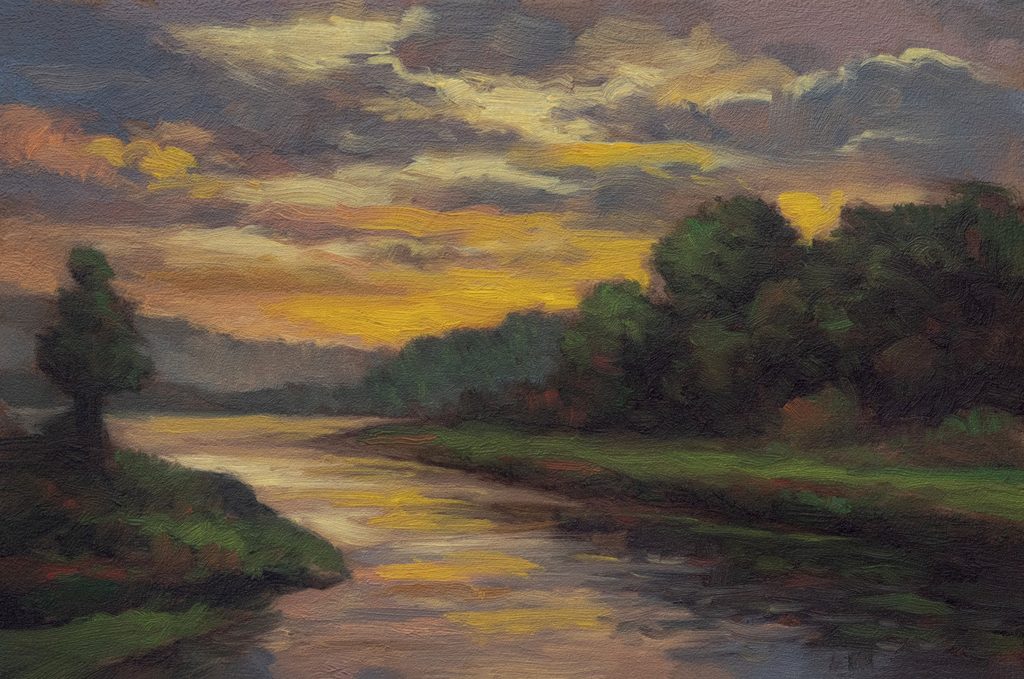
I painted this a couple days ago, and I’m real happy with it. I want to tell you the whole story of this little painting. I had the basic reference image sitting around for months and months, and there was something about it I really liked, but something about it that I didn’t like. One thing is, I mentioned this in one of my easel talks recently, I’m not that big on just ridges of hills without trees. This does have some trees going on and things, but in general it was just kind of not that thrilling. But what occurred to me, I was looking at it the other day, and I was thinking, you know what, all I gotta do is zoom in on the focal point, which is what I did. And I made a 4×6. This is the first of a series of 4x6s I’m doing, probably about seven or so.
The Brief and the Practice
The brief is pretty simple. I’m setting things up to do one a day, each day that I’m in the studio painting. So I set up a whole bunch, and I’m just going to go in and do them, line them up, knock them down. A couple reasons for that. One, I do well with the little paintings. The tourist season’s coming up. Also, I need some paintings that I can use for sales purposes and things like that too. So the little minis are perfect for that. I think you guys like watching me do little minis.
Couple Things to Keep in Mind When Going After Minis
Couple things you want to keep in mind when going after minis. One is it’s not the time or place to start getting real detailed, it’s very small. So that’s a big plus. If you look at the scale of this brush, it’d be like if this was an 8×12, it’d be like I was painting it with a 6 or so. This looks to be a 2. I tend to favor probably a 2 Robert Simmons flat as my largest brush for any of these. I also have the Silver Grand Prix, I use the zeros and the ones. And also the Doss little bristle flats. Those are usually around number 2s as well. I don’t use really big brushes, but I don’t use super tiny brushes either. I don’t think that’s good. You don’t want to start getting into sable mode and getting out your loop and painting the wings on angels.
One of the big attractions in this painting of course was the sky. It’s got gray contrasted with orange and yellow. One of the big things you’ve got, gray and orange, I love painting that kind of sky.
How I Work in the Studio
For example, I might have a good four or five working days in a week in the studio where I’m going in and painting. In the case of these little minis, that’s four or five little mini paintings. A lot of times what I’ll do with slightly larger work is come and do the underpainting one day, a color mix, and then come in and do the sky the next day and the rest of the painting, or break up the painting like that.
You can see here I’m leaning in the corner of that brush quite a lot, and that is a flat Robert Simmons Signet series. I’ve been using those a lot lately. I’d kind of phased them out, but I lean into that corner. The corner of a brush like this gives you the ability to sort of work with it like it was a smaller brush. That’s why I always favored the flats in the old days. With the bristle filberts, which I tend to favor quite a lot these days, I probably favor those less so on the mini paintings where I’m used to leaning into that little flat thing. There’s another tip for you: you learn how to use the corner of your brush if you’re going to make minis.
Minis Are a Mindset
But mainly, doing the minis is a mindset. Some people would call it a study, but for me it’s just as legitimate as a large painting. I really don’t make any distinction there. What I absolutely love about doing miniature paintings is that a flick of the wrist and you’ve done a tree. It’s all about that. It’s all about getting in, getting things done and moving on and not belaboring things. They’re great for that.
So take up the mini practice. Set up some reference, pick maybe five images you want to do. Do a painting a day, four by six. You can do it. Generally, I try to cap them at around two hours. That keeps things fresh. It’s fairly small, and I recommend it.
Aerial Perspective and Composition
So I wanted a recession. I wanted an aerial perspective thing. It was sort of in the reference, but things were quite indistinct. In a sense I wanted to retain that indistinctness. The unpainted area that’s right behind the mass of trees there, I ended up just kind of mixing a little bit of green, a little bit of gray, a little bit of orange, everything together. I’m pretty happy with the way it turned out. If it was maybe a little bigger, I probably would have spent a little more time exploring it. But this is the kind of thing in painting that when it comes up for me, I’m always feeling a bit challenged and always looking for ways to get better.
With these rivers, you know, I wanted to, you could just have it all taper off on the end. But a lot of times I think if you can, it’s good to kind of start pointing things back in. I’m pretty happy with the way that turned out. Another hesitation on this sort of scene for me was this massive land on our right. Essentially the grassy area is like a big diagonal wedge, and I did my best to sort of soften it and make it work well. I’m pretty happy with the result. But I’m not always that in love with wedge type shapes in a painting.
Reflections and Still Water
I didn’t get too hung up on the reflections. I’ve been doing a lot of reflection type things lately. I have to say more still water type situations are always a bit more challenging. Invariably, I feel like I don’t get things lined up as accurately as I maybe should. It wasn’t a problem here at all with this little river painting.
A Lifetime Process
I’ve been doing this a long time. So I don’t really care how long you’ve been working at landscape painting. It’s a lifetime process as far as getting really, really accomplished with it. And that said, you could start doing pretty masterful work at any point. I think the main difference is that you do less bad work as you progress. You get a kind of masterpiece in there now and again.
The Caveat on Minis
So minis are great. The only caveat I would give you is don’t paint minis exclusively. But paint a lot of them. You could paint three minis and then maybe something a bit larger just so you don’t get too constrained. The reason I really focused a lot on small paintings is having first of all been an illustrator. Illustrators tend to work at a table, something that will fit on a table. For two, I just knew that I could cover a lot more ground a lot more quickly by doing smaller paintings. You just learn so much more because you paint so many more scenes. Right now, what you see me doing, I was pretty happy with it. It was a little subdued, though. I thought we need some pop. We need a bit more color. So I broke out the old cad yellow and modified it with a bit of cad orange too.
Take good care of yourself. Stay out of trouble. And fight the power.
Mike’s New Site | Substack | Painting Website | Mailing List | Store | My Music | Support | Members Area
M Francis McCarthy, Your Painter in Residence