Woodland Stream 4×6 – 15 Min Painting Session!
Transcript and Key Insights
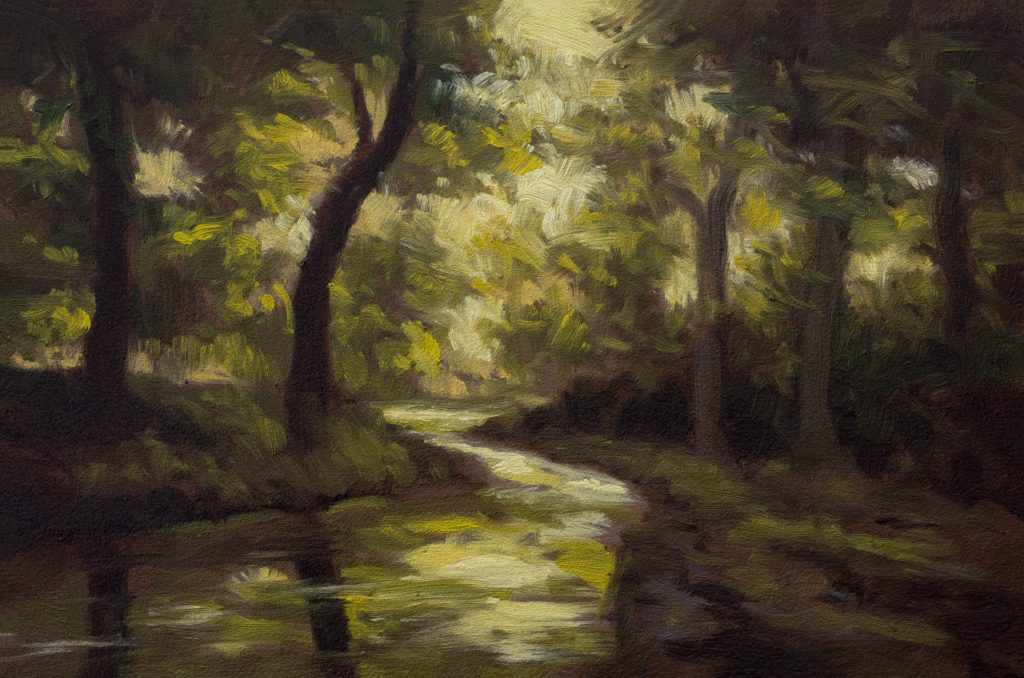
The painting I’m bringing you today is called Woodland Stream, painted on a 4×6 board. Recently, I decided to focus on producing several 4×6 paintings, which is a standard frame size and excellent for studies or miniatures.
Personally, I have always preferred the 5×7 format because it offers slightly more room to maneuver and move within the composition. However, I’ve noticed that 4×6s tend to sell much more rapidly. I suspect this is because they feel a little more precious and cute. Since I typically paint on MDF or similar substrates rather than stretched canvas, having a ready-made frame size is essential for these pieces.
Mastering Greens with Red Underpainting
For this piece, we are working on our typical deep soil color base. Tour Burnt Umber has been modified with Mars Black and Rose Madder. I specifically added the Rose Madder because Woodland Stream is a very green scene. While green reference scenes don’t always turn out predominantly green in the final work, I decided to embrace the greenness fully here.
The ground color supports this approach perfectly as it is complementary to green, possessing a reddish tone. Having extra red in the darks also helps because the secret to making greens thrive is having lots of red underneath, in, about, and around them. One of the major challenges for landscape painters is dealing with relentless greens, and the real solution lies in utilizing those reds. I’ve been imparting this message for over ten years; it remains one of the most valuable insights for tonal painting.
Placing Darks and Managing Black
In this session, you’ll see me setting in all the darks using Mars Black with a touch of burnt umber to ameliorate the pure blackness. I prefer Mars Black because I can thin it down significantly and get better coverage than I do with Ivory Black. Additionally, Ivory Black can sometimes behave unpredictably when used on its own.
While many painters avoid black entirely, mixing colors like burnt umber with ultramarine blue to create a chromatic near-black, I found that embracing real black was pivotal for my Tonalist results. In the early days of my channel, during the “100 Days of Tonalism,” I mixed Alizarin Crimson and Phthalo Green to achieve a dark chromatic black. However, it wasn’t until I started using true black that I began achieving the high-quality tonal effects I do today. Mars Black is perhaps a bit duller than Ivory Black in isolation, but in the context of a painting, it performs beautifully.
Composition: Paths vs. Streams
This particular work features a stream or creek rather than my usual path. There is a slight compositional difference between the two. When painting streams, you are dealing with reflections and water dynamics, which makes for a very fun challenge. I painted a similar successful work around 2016–2017 when I was deep into my texture phase.
While I am still fundamentally the same painter, working on textured surfaces requires different techniques, you have to push your brush into the board more aggressively to ensure paint gets into the grooves. Ultimately, these days, I prefer creating the textural feeling through the interaction and fracture of my brushwork itself rather than relying on physical texture in the substrate.
Surface Preferences: Why MDF?
My favorite surface to paint on by far is MDF (compressed wood pulp). Although I was enamored with hardboard for a long time, I’ve had more issues with it denting easily, even though “hard” board sounds tougher than “soft” MDF. I also prefer the flatness of MDF; hardboard can have a very subtle lump in its surface quality that I find slightly distracting.
I used to create texture using paint rollers or prepped smoother surfaces using tinted standing sealers on laminated boards, which produced a luminous quality but was expensive. These days, my prepped boards are coated with house paint (acrylic). For someone as prolific as myself, who believes in learning through extensive daily practice, board thickness matters. If you are painting every day on half-inch thick stretched canvas or thick hardboard, you will run out of storage space quickly. MDF offers the perfect balance of smoothness, durability, and thin profile for high-volume work.
A Note on Community and Resources
I want to mention that while this video gives a good overview, there is a more comprehensive video in my members area here on Substack, which includes detailed color mixing sessions and key insights I shared while painting.
Finally, I’d like to promote my book, which compiles 13 years of work on painting in a tonal manner. It is available for $65 with international shipping included (essential since shipping from New Zealand can be prohibitively expensive). This is strictly a physical book; I haven’t found e-format options suitable for high-quality art instruction yet. A follow-up four-volume set covering every aspect of landscape painting is currently in proofreading.
Great art touches everyone, and as humans become more freed up to pursue meaningful activities, painting’s importance will only grow. Whether you are an artist or just someone looking for meaning, I hope this session brings you some joy. Take care of yourself and your loved ones, stay out of trouble, and fight the power!
Mike’s New Site | Substack | Painting Website | Mailing List | Store | My Music | Support | Members Area
M Francis McCarthy, Your Painter in Residence